

Working With Dreams
Begin SImply
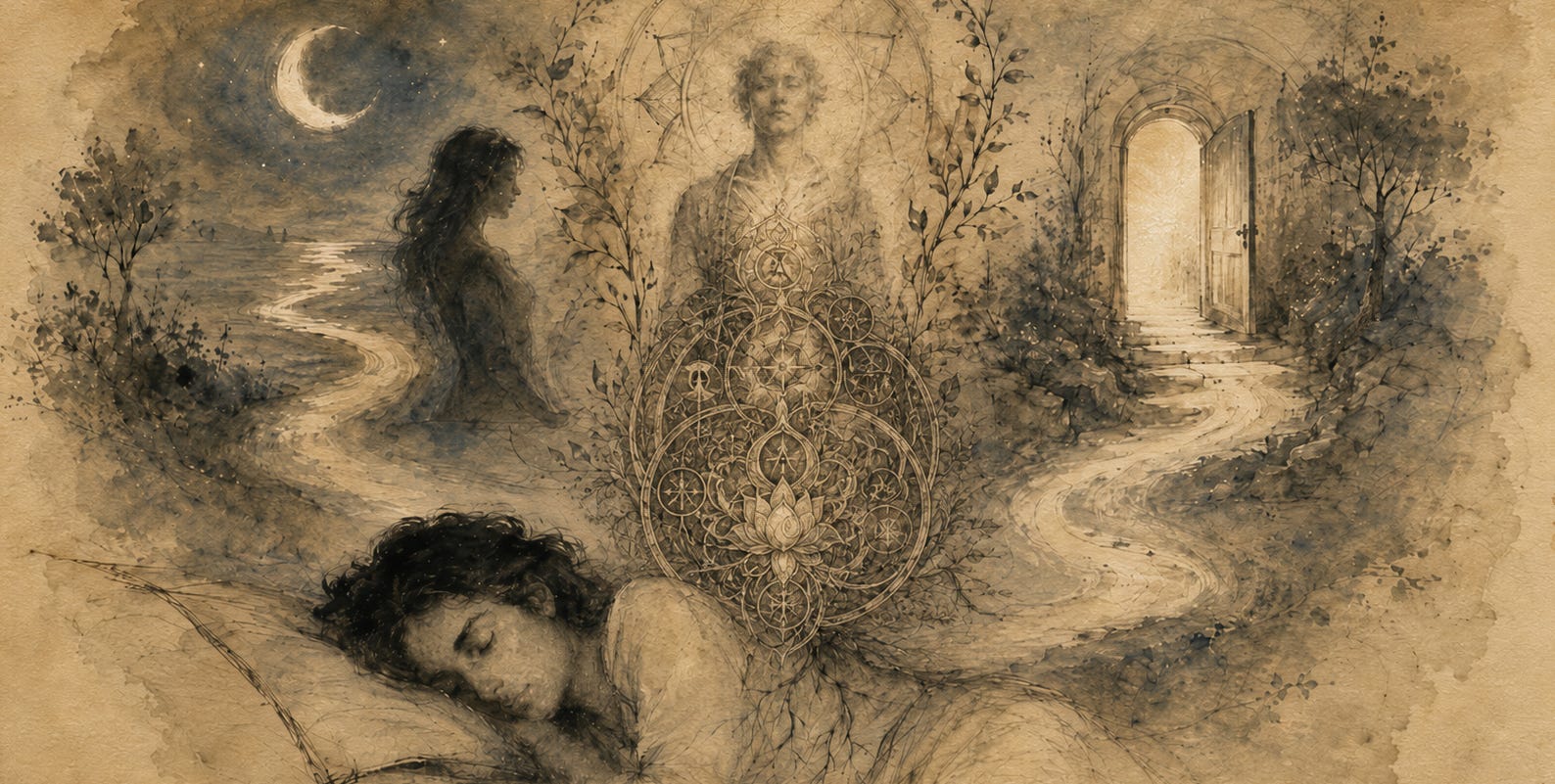
Sometimes a dream asks for your attention.
It may come as an image you cannot forget. A person from childhood. A deceased family member. A place you have never been, yet somehow know. A nightmare that returns. A strange scene that seems meaningless, but leaves a feeling behind.
You may wake with the sense that something has happened.
Not just in the dream, but in you.
Dreams speak in images, symbols, emotions, and body sensations. They do not usually arrive as explanations. They do not always tell us what to do. But they may point toward something that wants to be known.
A dream may ask us to remember.
To grieve.
To change.
To listen.
To become curious about a part of life we have been avoiding.
To notice a hidden door.
Why work with dreams?
Because something in you is already asking.
A dream that stays with you is not random in the ordinary sense. It may be carrying energy, feeling, or meaning that has not yet reached conscious thought.
Sometimes dreams bring old material forward: a forgotten house, a childhood landscape, a person we have not thought of in years. Sometimes they bring new images that feel mysterious or even absurd. Sometimes they bring fear. Sometimes they bring comfort. Sometimes they bring a sense of guidance.
The first step is not to interpret the dream too quickly.
The first step is to make room for it.
Begin simply
You can begin by remembering.
Keep a notebook by the bed. Write down whatever you can, even if it is only a fragment:
A color.
A room.
A road.
A person.
An animal.
A sentence.
A feeling.
A door.
If writing is difficult, draw something from the dream. Place an object near your bed that reminds you of it. Tell the dream to someone who will listen carefully and not immediately explain it away.
Then wait.
Dreams often unfold over time. The first meaning is rarely the only meaning.
Try not to say, “I know what this means” too quickly. Try not to say, “This means nothing” too quickly either.
Stay curious.
Assume there is more.
The dream as a threshold
A powerful dream can feel like a threshold experience.
It may arrive during grief, illness, retirement, caregiving, creative change, or a period when the old life no longer fits. It may appear when we are between identities, between decisions, or between one version of ourselves and another.
At these times, dreams may bring images from the deeper self.
Carl Jung understood dreams as one way the unconscious communicates with consciousness. In Jungian work, a dream is not treated as a puzzle to solve from the outside. It is approached as a living image, something to enter into relationship with.
What does the dream want us to notice?
Where is the energy?
What feeling remains in the body?
Which image will not leave us alone?
What might be trying to come through?
When a dream feels urgent
Some dreams feel like more than dreams.
They may wake us with a sense of alarm, wonder, grief, or recognition. They may feel as if they are asking for immediate attention. They may bring information that changes the way we understand a relationship, a loss, a decision, or our own life.
A dream like this should not be dismissed.
It may be useful to bring it to someone trained in dreamwork, Jungian coaching, Jungian analysis, or another depth-oriented approach. A skilled listener can help hold the dream open without reducing it too quickly.
The work is not to force a meaning onto the dream.
The work is to listen.
A few ways to begin
If a dream is asking for your attention, you might try:
Write it down before the day begins.
Give the dream a title.
Draw one image from it.
Notice the strongest feeling in the dream.
Ask which part of the dream feels most alive.
Imagine continuing the dream and asking one image or figure what it wants you to know.
Keep the dream nearby for several days.
Ask for another dream.
Dreamwork is not about controlling the dream.
It is about developing a relationship with the inner life.
The hidden door
A dream may not give us a direct answer.
Instead, it may open a door.
Behind that door may be grief we have not yet felt, a strength we have not claimed, a memory that needs compassion, or a future self beginning to take shape.
The dream may come as a mystery because the deepest changes in life often begin that way.
Not as a plan.
Not as advice.
Not as certainty.
But as an image, a feeling, a question, a path, a room, a figure, a door.
And if we are willing to listen, the dream may lead us somewhere we could not have reached by ordinary thinking alone.